GEMSEO at EASN 2026
GEMSEO featured in seven talks given by the GEMSEO team and its partners at the 16th EASN International Conference on Innovation in Aviation & Space, held in Toulouse from 27 to 30 October 2026. They covered MDO teaching, aircraft design under uncertainty, SysML v2, discipline integration, bi-level MDO and safety analysis. The conference proceedings will be available in 2027.
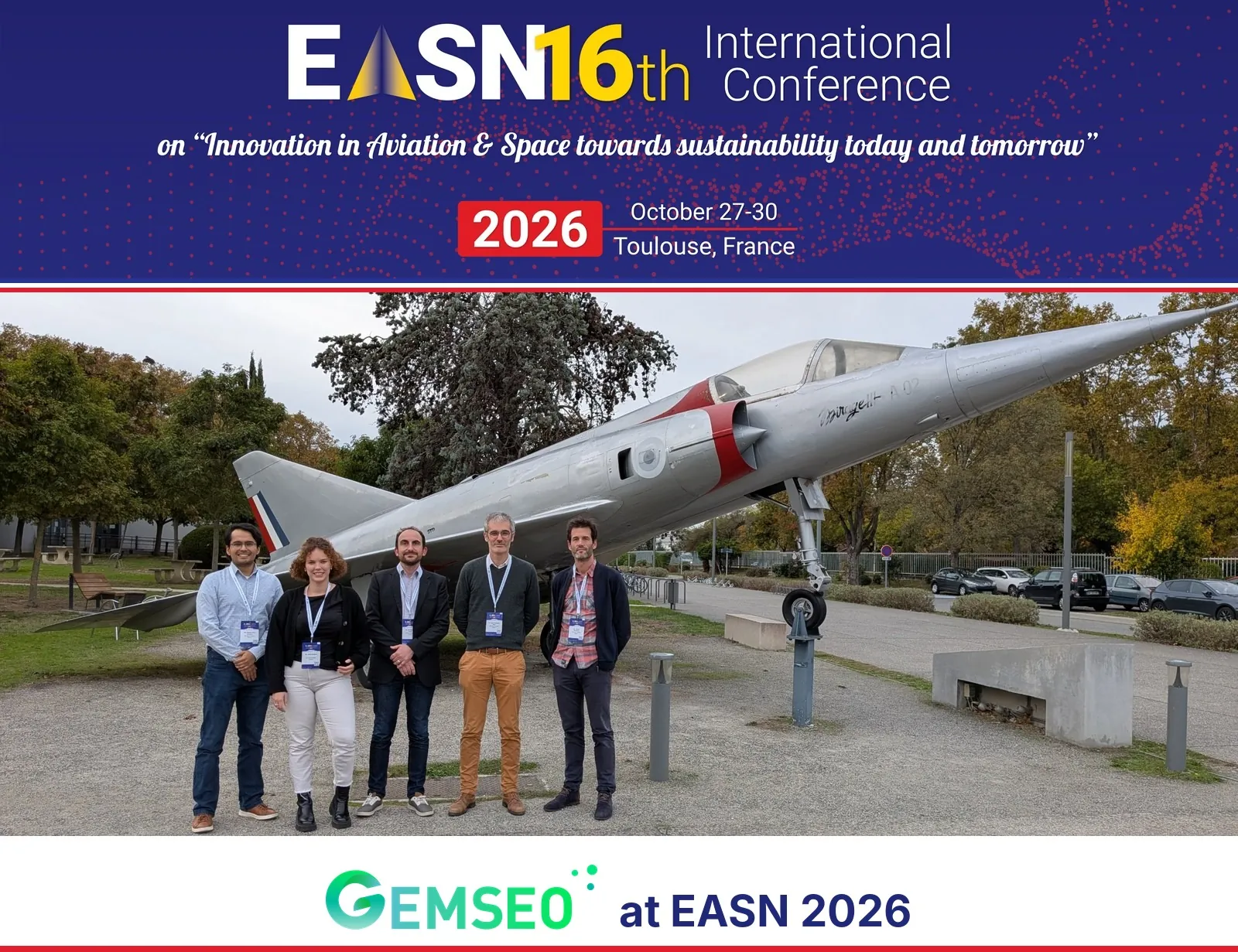
Presenters are in bold.
MDO teaching
A Training-Oriented Hydrogen, Kerosene, and Battery Aircraft Design MDO Problem with Uncertainties
Dajung Kim1, Thierry Druot1, Nicolas Peteilh1, Omar Hammami2, Matthias De Lozzo3 and François Gallard3
1 ENAC, 2 ENSTA, 3 IRT Saint Exupéry
ENAC designed this use case for its MDO courses: a 150-passenger airliner whose sizing loop gathers 14 functions in about 400 lines and runs almost instantly.
Two arguments switch between four aircraft, a kerosene turbofan, a hydrogen turbofan, a hydrogen fuel cell and a battery electrofan, all minimising the take-off mass under take-off, approach, climb and wing span constraints.
IRT Saint Exupéry implemented it in gemseo-oad-training, and ENAC and ENSTA now teach with it.
The talk illustrated its potential with three example training scenarios.
The first one addresses physical design reasoning: students compare the optimal aircraft of the four energy chains, trace a technology parameter through the sizing loop down to the take-off mass, and sweep it to find when it changes the conclusion.
The second one addresses MDO formulation and numerics: students solve the same problem with MDF and IDF, with and without derivatives, from several starting points, and compare robustness and cost.
The third one addresses design under uncertainty: from six uncertain inputs, students check whether the deterministic optimum remains feasible, identify the inputs driving the uncertainty, and design a robust aircraft.
Aircraft design under uncertainty
Reliability-based Overall Aircraft Design using GEMSEO
Matthias De Lozzo1, Nicolas Roussouly1 and Olivier Sapin1
1 IRT Saint Exupéry
On the training use case above, five parameters are uncertain and the constraints must hold with a probability of 99.9%, which crude Monte Carlo would need about a million evaluations to check. This talk, from the R-Evol2 project at IRT Saint Exupéry, used the new reliability features of GEMSEO v7 to chain a deterministic MDO, a reliability-based MDO, a reliability analysis and a reliability-oriented sensitivity analysis. The reliability-based MDO uses sequential optimisation and reliability assessment (SORA) with the inverse first-order reliability method (FORM); FORM-based importance sampling cheaply estimates the probabilities and the Sobol' and target Hilbert-Schmidt independence criterion (HSIC) indices. Margins of one to three standard deviations left a violation probability of 11% at best, whereas SORA met the 0.1% target with only 0.7% more mass, for less than 20 times their cost. The gravimetric index and the structure efficiency factor drive the take-off distance violations, mostly through interactions, and a new uncertain coupling graph shows how uncertainty spreads across the disciplines.
Sequential Sampling Algorithm for the Design of a Hybrid-Electric Regional Aircraft under Uncertainty
Romain Espoeys1, Matthias De Lozzo1, Sylvain Béchet1 and Jean-Christophe Giret1
1 IRT Saint Exupéry
The European project ODE4HERA studies a hybrid-electric regional aircraft. Optimising it under uncertainty means estimating statistics by Monte Carlo at every design point, whose variability decreases slowly: ten times more accuracy requires a hundred times more samples. This talk presented SeqUMDO, a multi-fidelity strategy solving the MDO problem under uncertainty at three levels, each starting from the solution of the previous one. From one level to the next, the number of samples increases, e.g. from 10 to 160, while the optimiser tolerance decreases, e.g. from 10⁻¹ to 10⁻⁸: most iterations use cheap rough estimates, and only the last ones, close to the optimum, pay for accurate ones. Over 50 repetitions on the training use case above, it found the same optimum as crude sampling for a median cost more than 10 percentage points of the budget lower, and never used more than 70% of it. On a surrogate model of the ODE4HERA aircraft, maximising the mean range under nine constraints, it used 40% to 50% of the budget instead of 50% to 74%, a median saving of almost 20 points.
SysML v2 and MDAO
Extending SysML v2-Based MBSE–MDAO Integration to Uncertainty and Multi-Fidelity Optimisation: Application with GEMSEO to a Hybrid-Electric Regional Aircraft
Jean-Christophe Giret1, Jean-Marie Gauthier1, Sylvain Béchet1, Romain Espoeys1, Matthias De Lozzo1, Mickael Guillen1, Sparsh Garg2, Jasper Bussemaker2, Francesco Torrigiani2, Simone Mancini3 and Tim Klaproth3
1 IRT Saint Exupéry, 2 DLR, 3 Airbus Defence and Space
On the same aircraft, the ODE4HERA partners connect model-based systems engineering (MBSE) and MDAO: SysML v2 system models feed the MDAO studies run with GEMSEO.
The gemseo-sysml plugin reads the models, built on the ODE4HERA ontology, and sets up the MDAO problem: disciplines, design space, objective and constraints.
Once the optimisation is done, it writes the results back to the models and checks which requirements the design meets.
The talk extended this MBSE–MDAO link to uncertainty and multi-fidelity optimisation.
The approach was successfully applied to the hybrid-electric regional aircraft.
Discipline integration
A data model centered MDO discipline integration in GEMSEO applied to industrial conceptual aircraft design
François Gallard1, Fabian Castaneda1, Gilberto Ruiz Jimenez1, Antoine Dechaume1, Julian Bardin2 and Antoine DeBlois2
1 IRT Saint Exupéry, 2 Bombardier
Bombardier and IRT Saint Exupéry worked together on integrating MDO disciplines in GEMSEO. The disciplines are organised around a shared data model and exchange their data through it. The talk showed this approach on an industrial conceptual aircraft design process, where it led to 30% less integration code than the previous process.
Bi-level MDO
Acceleration of the Bi-Level BCD MDO Architecture Applied to Aircraft Design
Shubham Deshmukh1,2,3, François Gallard3, Joel Brezillon1, Anne Gazaix1, Andrea Brugnoli2 and Joseph Morlier2
1 Airbus, 2 ISAE-SUPAERO, 3 IRT Saint Exupéry
The bi-level block coordinate descent (BCD) architecture splits an aero-structural design problem into blocks, such as an aerodynamic optimisation and a structural sizing optimisation, so that each team keeps its own tools, data and expertise. Each BCD sweep optimises the blocks one after the other, the others being fixed, until the design variables reach a fixed point; as each block is an expensive optimisation, every sweep counts. Acceleration methods, such as Anderson acceleration, reuse past iterates to reach this fixed point faster, but their extrapolation can leave the bounds of the design variables, and a bound becoming active makes the residual non-smooth, which breaks their local linear model. This PhD work, between Airbus, ISAE-SUPAERO and IRT Saint Exupéry, projects the extrapolation onto the bounds and restarts the history when the set of active bounds changes, for any history-based method: Anderson, minimal polynomial extrapolation, secant and Aitken. On a modified Sellar problem, the restart made all four methods converge about three times faster, and more than thirty times faster than the BCD without acceleration. On an aero-structural wing design problem, Anderson acceleration with projection and restart also converged faster than the plain BCD and than Anderson acceleration without restart. These acceleration methods, bound strategies and restarts have been implemented in GEMSEO.
Safety analysis
Using Continuous-Time Markov Chains for Model-Based Safety Analysis
Olivier Sapin1, Matthias De Lozzo1, Tony Ghueldre1, Tatiana Prosvirnova2 and Christel Seguin2
1 IRT Saint Exupéry, 2 ONERA
A continuous-time Markov chain (CTMC) models a system as states linked by failure events, each with a rate.
Solving it gives the exact probability of an undesired event, even when the order of the failures matters or a failure stays hidden until the next check.
Writing such a chain by hand is out of reach for a real system.
This talk, from the CoSMoS project at IRT Saint Exupéry, presented the gemseo-mbsa plugin: one describes the components and their failure modes, and it generates every reachable state and solves the chain exactly.
For short exposure times, it also gives a readable formula, which recovers the ARP4761A rules for failure order and latent failures instead of applying them by hand, and lists the failure combinations that carry the risk.
On the ARP4761A brake system control unit, the chain has 26,244 states, is generated in 22 s and solved in 6 ms.
Its 2.7 million failure sequences of up to six failures match those of an AltaRica model exactly.
As the chain is a GEMSEO discipline, the safety model plugs into sensitivity analysis and reliability allocation studies.
Availability
- GEMSEO v7 will include the reliability techniques and visualisations, and the data-model-centred discipline integration.
- The next
gemseo-umdorelease will include the sequential sampling algorithm. gemseo-sysmlandgemseo-oad-trainingare already available.gemseo-mbsais open source and listed in the plugins catalog; its first release is coming soon.
To discuss this work in person, come to the GEMSEO User Days on 26 and 27 November at IRT Saint Exupéry, Toulouse; registration closes on 15 November.